From a Single Reference Genome to the Human Pangenome: Time to Upgrade Primer Evaluation
In PCR, multiplex amplification, targeted library construction, and molecular diagnostics R&D, primer specificity checking is virtually a standard step. We have long relied on hg19/hg38 as the background reference—useful, but increasingly insufficient.
The reason is simple: real human populations are not photocopies of a single reference sequence. Especially in regions such as the MHC and certain pharmacogene-associated loci, where haplotype diversity is high and paralogs abound, a primer that "looks fine" on a single reference genome may fail to amplify—or co-amplify multiple loci—when applied to another individual’s genome.
The human pan-genome, advanced by the Human Pan-genome Reference Consortium (HPRC), aims to capture this diversity more completely. For primer design and quality control, the natural next step is:
Don’t just ask "Can it amplify on hg38?"
Ask instead: "Across multiple human assemblies, is coverage robust?"
MFEprimer’s New Feature: Human Pan-genome Primer Check
MFEprimer, the primer design and quality-control platform long maintained by iGeneTech, now offers the Human Pan-genome Primer Check.
The core workflow is straightforward:
· Submit a forward/reverse primer pair
· The system runs specificity analysis against a fixed set of 97 HPRC human assemblies
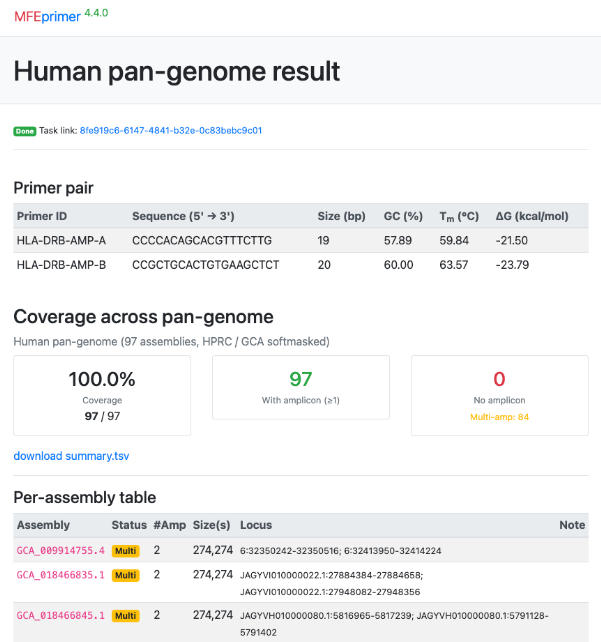
· It reports the coverage rate and the per-assembly result status:
Status | Meaning |
OK | Exactly one amplicon within the window |
Multi | Multiple amplicons (still counted as covered, but flags possible multi-target amplification) |
No amp | No valid amplicon |
Well suited for:
· Evaluating whether diagnostic/panel primers are robust against human genetic diversity
· Troubleshooting "amplifies in some samples but not others" in highly polymorphic regions such as the MHC
· Adding an extra layer of in silico coverage evidence before delivery or literature validation
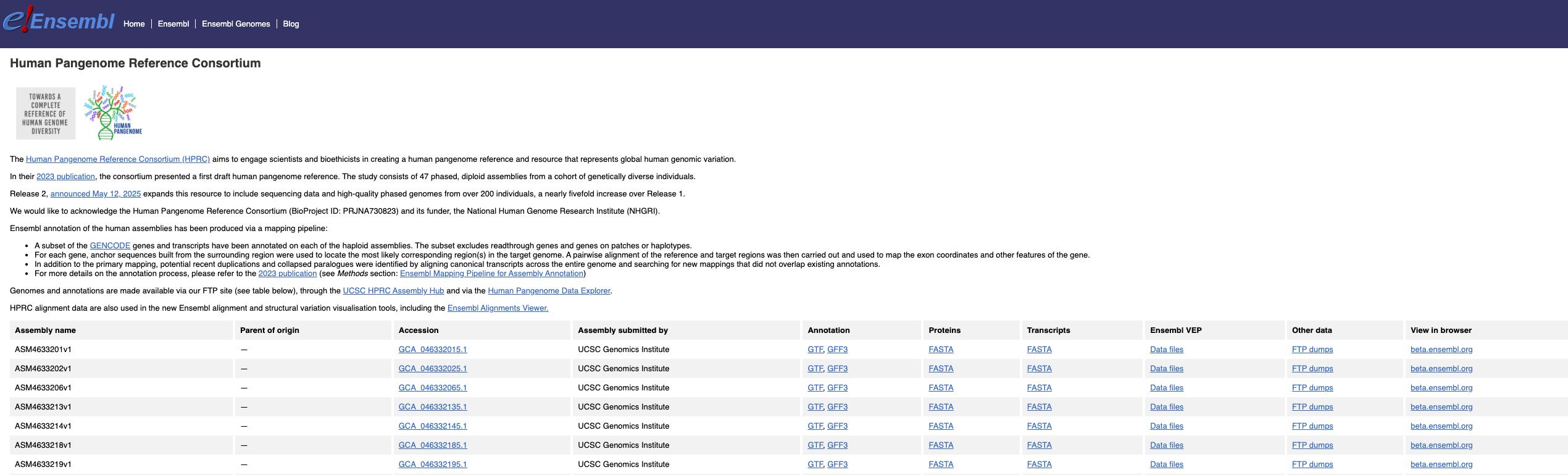
Assembly data come from HPRC and can be browsed and downloaded via Ensembl:
https://projects.ensembl.org/hprc/
How Does It Differ from Existing Modules?
In one sentence:
For microbes, we look at inter-strain coverage; for human, inter-assembly coverage—different scenarios, separate entry points, clearer.
Module | Question it is better at answering |
Specificity Check | What potential amplicons exist on the selected background (e.g., hg38, transcriptome library) |
Coverage for Microbes | Coverage of a primer pair across multi-strain viral/microbial libraries |
Pan-genome check (new) | Whether a primer pair amplifies broadly across the human pan-genome collection |
How to Use It (Up and Running in About 1 Minute)
· Open: https://m4.igenetech.com/panspec/
· Paste a primer pair (the default example is the classic HLA-DRB exon 2 primers)
· Adjust Tm and amplicon length window as needed (3′ mismatch fixed at 0)
· Click Run and bookmark the task link; the results page shows progress and a per-assembly table
Documentation:
https://www.mfeprimer.com/panspec/
Example: Why HLA-DRB?
The default primers are the classic HLA-DRB exon 2 amplicon pair (AMP-A / AMP-B, ~274 bp product), derived from the 11th International Histocompatibility Workshop (11th IHW) standard sequences and also documented in related literature (PMID: 23441825).
It was chosen as the demo because the MHC class II region is highly diverse, making it easy to observe the distribution of OK / Multi / No amp outcomes across HPRC assemblies—exactly illustrating the value of "pan-genome evaluation," rather than merely producing an "everyone passed" report card.
You can view the example results directly (pinned display, not periodically cleared):
https://m4.igenetech.com/panspec/demo/8fe919c6-6147-4841-b32e-0c83bebc9c01
In Closing
From MFEprimer-1.0 (2009) to today’s web platform, iGeneTech has always treated "whether a primer works and whether it amplifies promiscuously" as a fundamental question for molecular experiments. The human pan-genome is not an end point, but it is enough to remind us:
Reference genomes evolve; quality-control standards should keep pace.
We welcome you to try the new module and to share your use cases and suggestions with us.
For more products and technical solutions, visit the iGeneTech website: https://www.igenetech.com/
Follow our official account: iGeneTech (艾吉泰康)
 CN
CN