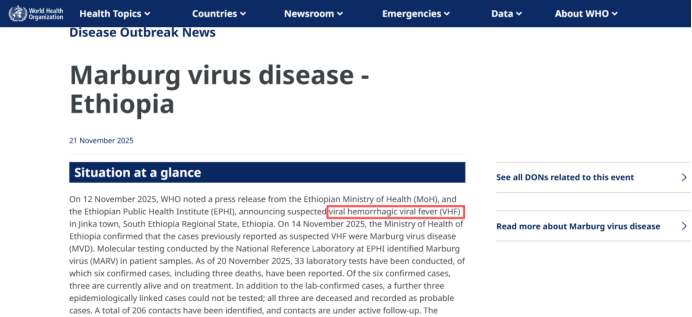
Recently, the World Health Organization (WHO) reported that the suspected cases of Viral Hemorrhagic Fever (VHF) reported in Jimma Town, Southern Nations, Nationalities, and Peoples' Region of Ethiopia have been laboratory-confirmed as Marburg Virus Disease (MVD). Medically, diseases characterized by fever and systemic or local hemorrhage as core clinical manifestations—including Marburg Virus Disease—are collectively referred to as "Febrile Hemorrhagic Syndrome".
This disease is mostly induced by pathogen infection, featuring high pathogenicity and potential risk of human-to-human transmission. Its core pathogenesis is as follows: after invading the body, the pathogen activates immune cells to release inflammatory factors through replication and proliferation. On one hand, this induces fever; on the other hand, it directly damages vascular endothelial cells and impairs the integrity of the vascular barrier, thereby triggering coagulation dysfunction. Eventually, a pathological vicious cycle of "inflammation activation - endothelial injury - coagulation abnormalities" is formed.
Based on its independently developed TargetSeq® liquid phase hybridization capture sequencing technology, iGeneTech has launched a panel for identifying 29 common pathogenic microorganisms associated with Febrile Hemorrhagic Syndrome, with reference to sequences of multiple strains included in the NCBI database.
Among these pathogens, 10 types of bacteria and parasites adopt a probe design strategy of "intraspecies conservation and interspecies specificity", while 19 types of viruses use a full-length coverage design approach. A total of 19,925 probes have been designed, covering 29 common pathogens causing febrile hemorrhagic infections. This panel can enhance the surveillance of pathogenic spectra of hemorrhagic fever in populations, provide important support for epidemic trend assessment, early outbreak identification and risk analysis, and meet the needs of routine prevention and control work of disease control and prevention departments.
Table 1: Pathogenic Microorganisms Included in the Febrile Hemorrhagic Syndrome Identification Probe Panel
Category | Pathogen Name |
Virus | Dengue virus |
| Yellow fever virus |
| Puumala virus |
| Sabia virus |
| Omsk hemorrhagic fever virus |
| Hantaan virus |
| Seoul virus |
| Andes virus |
| Dobrava-Belgrade virus |
| Machupo virus |
| Ebola virus |
| Marburg virus |
| Guanarito virus |
| Crimean-Congo hemorrhagic fever virus |
| Junin virus |
| Lassa virus |
| Rift Valley fever virus |
| Kyasanur Forest disease virus |
Bacteria | Leptospira |
| Group A Streptococcus |
| Streptococcus suis |
| Staphylococcus aureus |
| Anaplasma phagocytophilum |
| Yersinia pestis |
| Neisseria meningitidis |
Parasite | Plasmodium vivax |
| Leishmania donovani |
| Plasmodium falciparum |
Experimental Workflow
1. Nucleic Acid Extraction (0.5h)
2. Library Preparation (2.5h)
3. Probe Capture (3h)
(Supplementary: Library-Probe Hybridization 0.5-1h)
4. Sequencing (3h)
5. Data Analysis
Product Advantages
01 Broad Sample Compatibility, No Culture Required
Supports a variety of raw sample types including sewage, human-derived, and environmental samples. No pre-culture or host removal steps are needed, which greatly simplifies the pre-processing workflow and significantly improves detection efficiency.
02 Broad Strain Coverage, Complete and Reliable Data
Based on high-efficiency probe hybridization capture and enrichment technology, it enables accurate and unbiased identification and detection of sample genomes.
03 Excellent Sensitivity to Capture Weak Signals
Aiming at the core challenge of low-load infections, probe optimization enables efficient binding and enrichment of target sequences. Even trace amounts of pathogen nucleic acids can be stably captured, laying a solid foundation for downstream high-sensitivity detection.
04 Efficient and Rapid Hybridization Process
Based on TargetSeq® liquid-phase hybridization capture technology, library-probe hybridization takes only 0.5–1 hour. Combined with rapid nucleic acid extraction, library preparation, and sequencing workflows, the overall detection cycle is greatly shortened.
End-to-End Hassle-Free Detection
We maintain sufficient stock of identification probe kits for gastrointestinal, respiratory, and febrile hemorrhagic syndrome pathogens. These kits are paired with magnetic bead-based extraction kits, RNA pathogen library construction and capture kits, and DNA pathogen library construction and capture kits, enabling seamless integration from sample to data. The solution supports batch processing with automated liquid handling workstations and is compatible with multiple high-throughput sequencing platforms to meet the needs of different scenarios.
Product Info
Product Name | Speci. | Cat. No |
Fever with Bleeding Syndrome Panel | 16/96 rxn | PH2014821/PH2014822 |
Magnetic Beads Based Pathogen DNA / RNA Co-Extraction Kit | 50 rxn | E10021 |
Magnetic Bead Method Pathogenic DNA/RNA Extraction Kit | 50 rxn | E20011 |
IGT® Pathogen Microbial DNA & RNA Co-library Prep & Capture Kit (Illumina) | 16 rxn | C11891 |
IGT® Pathogen Microbial DNA & RNA Co-library Prep & Capture Kit(MGI) | 16 rxn | C11901 |
IGT-AS12 Automated Liquid Handling Workstation | Configuration III | Q91013 |
 CN
CN